Coming soon
The data in 60 seconds
What 31,177 reports are telling Colorado, and the question underneath them.
Each one is a person deciding to say something out loud to Safe2Tell. The Attorney General called the report one that tells “two stories at once.” Ours is a simpler question, and it is the one this page keeps coming back to: when someone speaks up in your building, who hears it?
A rise in reports can mean more need, more trust, or both. The data cannot tell us which. A building can, if someone goes in and listens.
The graduation rate is climbing, and the groups still below the state average are the groups most likely to tell us they do not feel seen. In our experience, the minute a student decides a school is not for them, every other intervention gets harder. Culture work is the one that comes first.
These are statewide and national figures. They describe patterns, and we do not present them as proof that any one program caused any one result.
| School year | Reports |
|---|---|
| 2023–24 | 28,218 |
| 2024–25 | 31,177 |
| Report type | Reports | Share of all reports |
|---|---|---|
| Suicide threats | 3,209 | 10.3% |
| Bullying | 2,673 | 8.6% |
| School safety concern: staff | 2,568 | 8.3% |
| Drugs | 1,628 | 5.2% |
| Welfare check | 1,538 | 4.9% |
Suicide threats were the most-reported type. Bullying and safety concerns about staff, two more of the top five, are the kinds of things a building’s culture shapes. Sources: Colorado Attorney General, Aug. 2025; Safe2Tell Annual Report 2024–25.
| Group | Percent |
|---|---|
| All students | 31.5% |
| Asian | 56.9% |
| Multiracial | 48.8% |
| Black | 45.9% |
| Hispanic | 39.4% |
| American Indian / Alaska Native | 38.0% |
| White | 17.3% |
| Indicator | Ever experienced racism | Never |
|---|---|---|
| Current poor mental health | 34.8% | 25.9% |
| Attempted suicide, past year | 15.0% | 6.7% |
| Current marijuana use | 21.8% | 14.5% |
| Prescription opioid misuse | 8.5% | 2.6% |
This is one survey at one moment, so it shows an association and not a cause. “Ever” includes students who answered rarely, sometimes, most of the time or always. Estimates for some groups carry wide margins of error. Source: CDC, MMWR Supplement 73(4), Youth Risk Behavior Survey, 2023.
| Graduating class | Rate |
|---|---|
| 2024 | 84.2% |
| 2025 | 85.6% |
Sources: Colorado Dept. of Education releases, Jan. 2025 and Jan. 2026, as reported by CPR News. Subgroup levels were not published in the coverage we reviewed, so we show direction only.
| Category | Share of reports |
|---|---|
| Valid | 96.6% |
| Unintended misuse | 1.2% |
| False | 2.2% |
Source: Safe2Tell Annual Report 2024–25; Colorado Attorney General, Oct. 2025.
The Colorado Department of Education’s Landscape of Wellbeing and Belonging describes five features. Two of them, the school environment and the relationships inside it, are the ones culture work changes.
Source: Colorado Dept. of Education, The Landscape of Wellbeing and Belonging. Highlighting is ours.
Three short films, each about a minute. Captions and a transcript will come with each one.
What 31,177 reports are telling Colorado, and the question underneath them.
What it looks like when someone watches how a building actually moves.
An introduction to Educator Truth Rooms, in the voices of the people who sit in them.
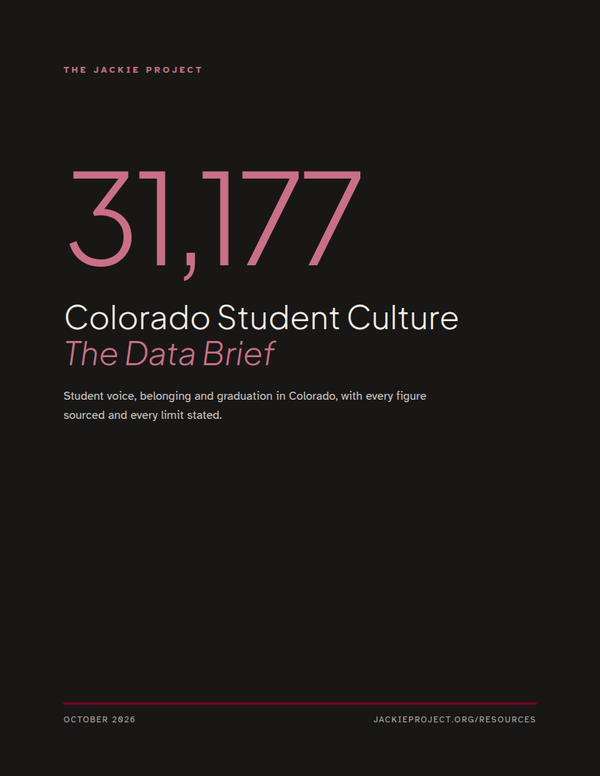
The tables behind the charts, the report types in full, the subgroup detail, and a plain account of what each number can and cannot tell you. Built to be printed, shared at a staff meeting, or attached to a grant.
Download the PDFThis is not a bag of worksheets. It is a complete system, built from lived practice, refined inside real buildings, and delivered in a specific order for a specific reason. Every piece earns the next one. Built inside schools, and designed to flex anywhere adults shape what young people inherit: youth-serving organizations, teams, and institutions.
Before we ever walk in, leadership sits with a structured reflection. Not a form. A reckoning on paper: the history of the building, what's been tried, what died on a shelf, what nobody's said out loud yet, and what they're actually hoping for. It's how we learn a community before we stand inside it, and it's the first honest conversation of the engagement.
Full days inside the building. Hallways at passing period. Classrooms mid-lesson. The front office when a parent walks in upset. The lunchroom, the sidelines, the spaces between. We watch how the building actually moves, not how it describes itself. Nothing is evaluated. No one is written up. Presence is the whole assignment.
Observation shows us what's visible. Anonymous voice surfaces what isn't: what people feel but haven't said out loud. Fully anonymous intakes for the people who live in the building, available in English and Spanish, never on paper and never with a name attached, because anonymity in a small building has to be protected by design, not by promise.
The mirror moment. We bring back what we saw and what the building told us, side by side. Delivered with care, grounded before it begins, and paced so the room can actually hear it. This is where a community meets itself honestly, sometimes for the first time. Everything built after this is built on what got named here.
"You can't teach what you won't confront."
The most judgment-free room an educator will ever sit in. A facilitated system for confronting bias honestly: grounding practices and self-talk tools taught before the hard part begins, an honest self-inventory, a daily noticing practice carried between sessions, and one anonymous story. Self-report only, always. Never staff reporting on staff. It closes in a facilitated Read-Out and ends in ritual, so no one leaves the room still carrying full weight.
The build. A complete culture architecture designed from what was actually observed and actually said: the values the community named, the practices that carry them, the language the building will use, and the curriculum that makes it teachable. Not templated. Not borrowed from another community. Co-designed with leadership and built to be run by the people who live there.
A framework nobody helps you live is a binder on a shelf. We stay through the hard part: facilitated staff development, live coaching, family and community engagement woven in, and progress check-ins that tell the truth. Not at you. Not about you. With you, until the culture holds on its own.
Every hard room we open, we close on purpose. Grounded openings, built-in pause points, and closing rituals that make sure the weight named in the room stays in the room. This is the thread through everything we do, because honest work is only sustainable when people are cared for inside of it. No one goes home carrying what they can't hold.
The data makes the case. The work makes the difference. Reach out and tell us what you're seeing.
Work With Us →